Custom Metal Badge Manufacturing Process | OEM & ODM Factory | Ninco
Learn how custom metal badges are made, from client design and 3D artwork to mold making, die casting, plating, quality inspection, packaging and delivery.
Ninco
7/5/20265 min read
From Design Concept to Finished Product
Custom metal badges are widely used for clothing brands, handbags, shoes, promotional gifts, uniforms, sports teams, events, and fashion accessories. Although a badge may look like a small detail, it often carries an important part of a brand’s identity.
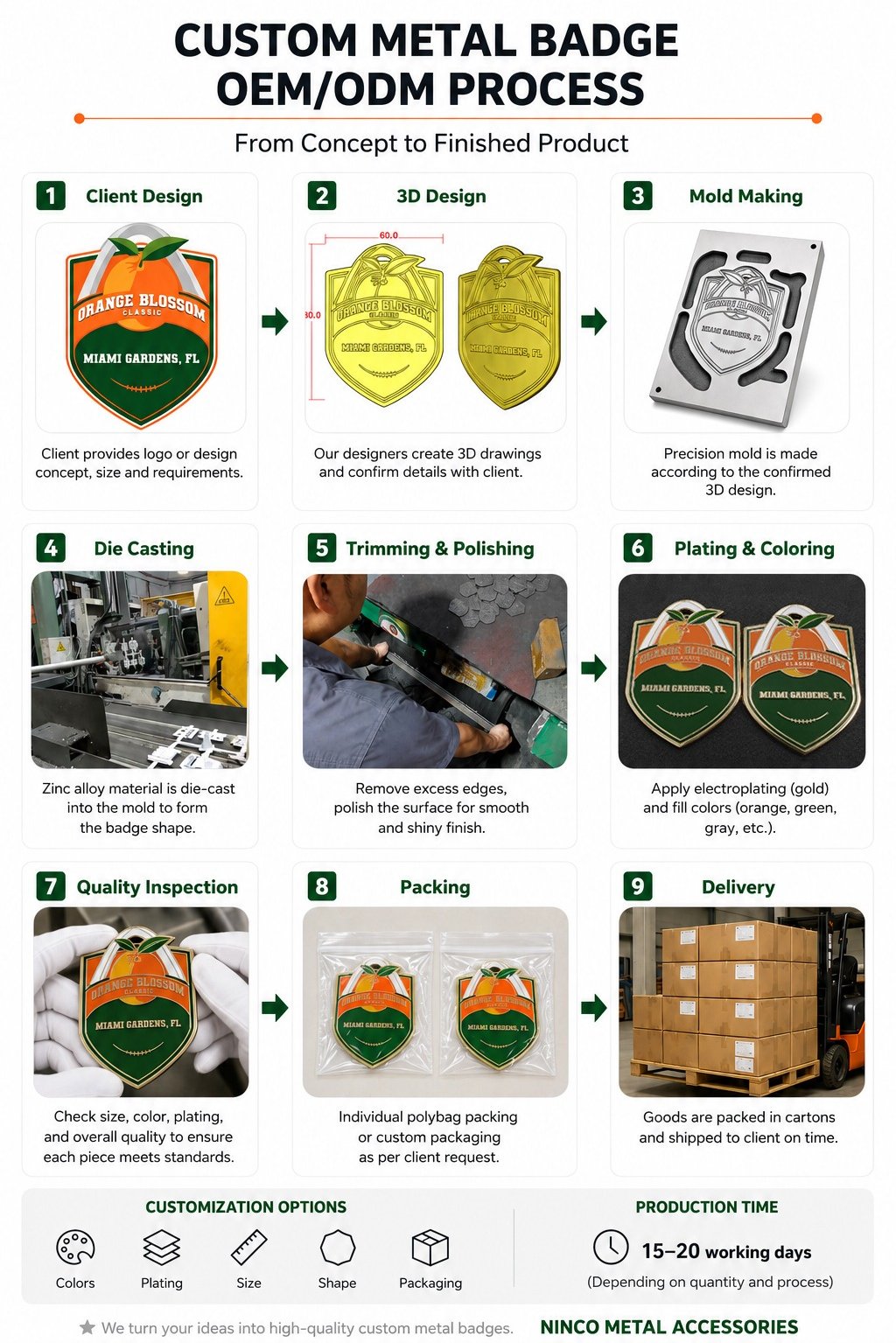
At Ninco Metal Accessories, we provide OEM and ODM manufacturing for custom metal badges and metal labels. From an initial logo or sketch to finished products ready for shipment, every step is carefully controlled to ensure the final badge matches the client’s design, color, quality, and application requirements.
This article explains our complete custom metal badge manufacturing process.
1. Client Design and Product Requirements
Explore our Custom Metal Pins & Badges
Every custom metal badge project starts with the client’s idea.
Clients can provide a logo, artwork, reference image, hand sketch, sample product, or simply describe the desired effect. At this stage, we normally confirm important product details, including:
Badge size and thickness
Shape and edge design
Material requirements
Logo position and lettering
Surface finish
Plating color
Color filling or enamel effect
Attachment method
Packaging requirements
Estimated order quantity
For example, a clothing badge may require sewing holes or insert pins, while a handbag metal label may use metal feet, rivets, adhesive backing, or screw fixing.
A clear confirmation at the beginning helps reduce revisions and makes the production process smoother.
2. 3D Design and Artwork Confirmation
After receiving the design information, our design team creates a professional 3D drawing.
The 3D artwork shows the final product structure before mold production. It allows the client to check details such as:
Overall badge shape
Logo depth and embossing
Raised and recessed areas
Text clarity
Hole positions
Border thickness
Backside structure
Attachment positions
Surface texture
For custom zinc alloy badges, the 3D drawing is especially important because it determines how the metal flows into the mold and how detailed elements will appear after die casting.
Once the client confirms the 3D artwork, we move forward with mold development. See Our Customizations Process.
3. Mold Making
The mold is one of the most important parts of custom metal badge production.
Based on the approved 3D design, a precision mold is made for die casting. The mold determines the product’s shape, dimensions, logo details, edges, and recessed areas.
A well-made mold helps ensure:
Clear logo details
Consistent product shape
Smooth edges
Stable dimensions
Better production efficiency
Reliable quality for repeat orders
For new custom badge designs, mold fees are usually required. However, once the mold is completed, it can be used again for future production orders of the same design.
4. Zinc Alloy Die Casting
After the mold is ready, the next step is die casting.
Most custom metal badges are made from zinc alloy because it is durable, easy to shape, and suitable for detailed logos and complex designs. During die casting, melted zinc alloy is injected into the mold under pressure.
After cooling, the metal badge blank is removed from the mold.
At this stage, the badge already has its basic shape, including:
Logo outlines
Raised text
Recessed logo areas
Borders
Holes
Attachment structures
Backside details
However, the surface is still rough and requires additional processing before it becomes a finished badge.
5. Trimming, Grinding and Polishing
After die casting, excess metal edges and casting gates are removed.
This step may include trimming, grinding, sanding, water polishing, manual polishing, or machine polishing, depending on the product structure and required surface finish.
The purpose is to make the badge cleaner, smoother, and more refined.
For example:
Matte badges may use sanding or brushed finishing.
Shiny badges may require mirror polishing.
Vintage badges may use antique plating and darker recessed areas.
Fashion labels may need smooth edges to avoid scratching clothing or bags.
Proper polishing is important because it directly affects the appearance of the final plating.
6. Plating and Color Filling
Once the surface is polished, the badge moves to plating and coloring.
Electroplating gives the metal badge its final metal appearance. Common plating options include:
Shiny gold
Matte gold
Light gold
Silver
Nickel
Antique silver
Antique brass
Gunmetal
Black nickel
Rose gold
Warm gold finishes
Custom color plating
After plating, color can be added to recessed areas through paint filling, soft enamel, epoxy coating, or other coloring processes.
For a custom badge with multiple colors, the raised metal lines separate each color area and create a clear, premium-looking design.
This process is suitable for logos, sports badges, brand labels, souvenir badges, fashion accessories, and promotional items.
7. Quality Inspection
Before packaging, every production batch goes through quality inspection.
Our quality control team checks important details such as:
Product size
Logo clarity
Surface finish
Plating consistency
Color accuracy
Color filling quality
Edge smoothness
Hole position
Attachment strength
Scratches or defects
Overall appearance
For clients with strict color requirements, we can follow approved samples, Pantone references, or color cards.
Quality inspection helps ensure that each custom metal badge meets the agreed production standard before shipment.
8. Packaging
Packaging can be customized according to the product type and client’s requirements.
Common packaging options include:
Individual polybag packaging
Tissue paper wrapping
Custom backing cards
Gift boxes
Bulk carton packaging
Individual packaging is often used for high-end metal badges, branded accessories, gifts, and retail products. Bulk packaging may be more suitable for garment factories, bag factories, and large-volume production orders.
We can also help clients choose packaging that protects the plating surface during transportation.
9. Delivery and Shipment
After final inspection and packaging, the finished custom metal badges are packed into export cartons and prepared for shipment.
We can support different shipping methods according to order quantity, destination, and delivery time requirements, including:
Express delivery
Air shipment
Sea shipment
Freight forwarder delivery
Customer-appointed shipping agent
Our goal is to deliver products safely, efficiently, and on time.
Customization Options for Metal Badges
At Ninco Metal Accessories, custom metal badges can be made in different styles based on your branding and application needs.
We support customization for:
Size
Shape
Thickness
Logo
Plating color
Surface texture
Color filling
Attachment method
Packaging
Backside design
Custom barcode or label packaging
Whether you need a small fashion logo badge, a large custom emblem, a handbag metal label, a uniform badge, or a promotional metal accessory, we can support your project from artwork development to mass production.
Production Time for Custom Metal Badges
Production time depends on the badge size, design complexity, plating process, color quantity, order quantity, and packaging requirements.
For most custom metal badge orders:
Artwork confirmation: around 1–3 working days
Mold making: around 7–10 working days
Mass production: around 15–20 working days after sample or artwork confirmation
For urgent projects, please share your required delivery date in advance so we can evaluate the production schedule.
Start Your Custom Metal Badge Project
A professional custom metal badge can make clothing, bags, shoes, gifts, and branded products look more distinctive and premium.
Send us your logo, artwork, sample photo, or design idea, and our team will help you evaluate the best material, production process, plating option, attachment method, and packaging solution.
Ninco Metal Accessories specializes in custom metal labels, badges, zipper pulls, buttons, buckles, bag hardware, and zinc alloy accessories.
Contact us today to start your OEM or ODM custom metal badge project.
FAQ Section
What material is used for custom metal badges?
Zinc alloy is commonly used because it can create detailed logos, raised text, recessed areas, and complex shapes. Other materials such as brass, iron, stainless steel, or aluminum may also be available depending on the design.
Can I make a metal badge from only a logo or sketch?
Yes. You can send us your logo, hand sketch, reference image, or sample photo. Our design team can help create a production drawing for confirmation.
Can I choose different plating colors?
Yes. Common options include gold, silver, gunmetal, black nickel, antique brass, antique silver, rose gold, and other custom finishes.
Can custom metal badges have multiple colors?
Yes. We can add colors through paint filling, soft enamel, epoxy coating, or other coloring processes.
What is the MOQ for custom metal badges?
MOQ depends on the badge size, process, plating, color quantity, and packaging requirements. Contact us with your design for a quotation.
How long does production take?
Most custom orders require approximately 15–20 working days after artwork and sample details are confirmed. Complex designs or special packaging may require additional time.
Ready to Start Your Custom Metal Badge Project?
Send us your logo, reference image or design idea.
We will help recommend the right material, finish, attachment method and production process.
Contact
Get in touch for custom solutions.
CONTACT
Connect
lucy@nincofactory.com
© 2026 Ninco. All rights reserved.